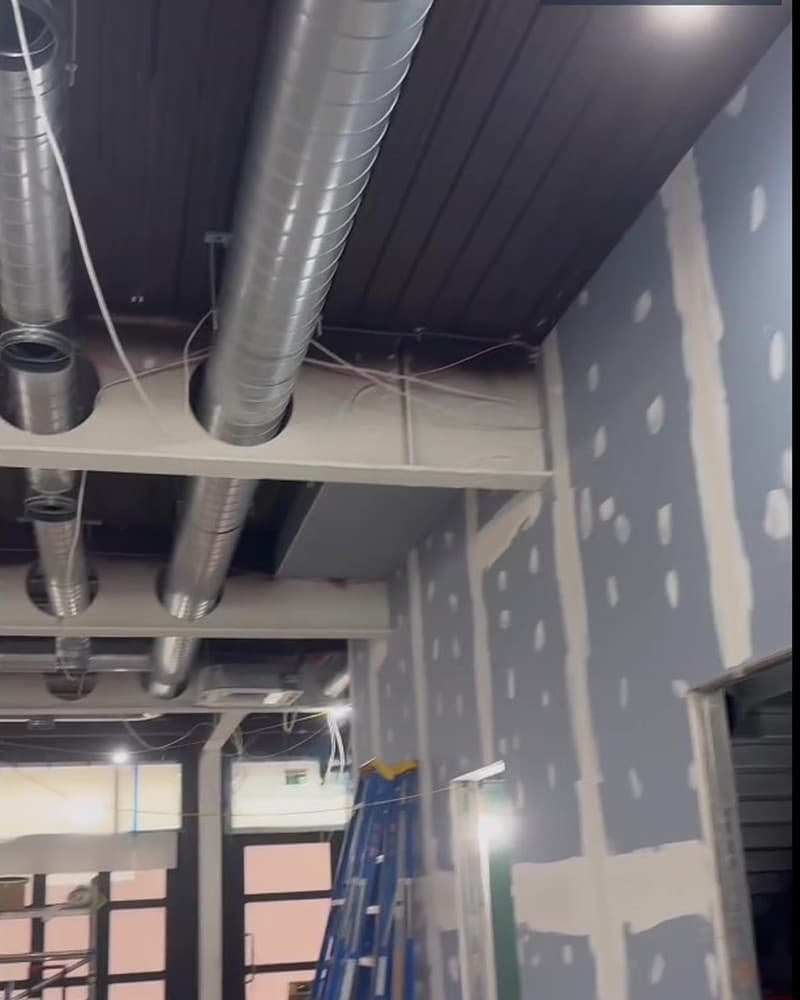
A £200,000 refurbishment is often described as a “small project”. Contractually, however, that description can be misleading.
Two refurbishment projects with the same construction value can carry very different levels of risk. One may involve little more than finishes, partitions and straightforward services. Another may involve structural alterations, work to an occupied building, significant MEP modifications, contractor-designed elements and a programme where a few weeks of delay has substantial commercial consequences.
The appropriate contract should therefore be selected around the nature of the project and the way it needs to be managed, rather than against an arbitrary monetary threshold.
For many private-sector refurbishments, the starting point will be within the JCT family. In other circumstances, NEC can provide a useful management framework even at relatively modest contract values.
The question should not simply be “JCT or NEC?”. A better question is: what contractual controls does this particular project require?
Start with the project, not the contract value
Before selecting a form of contract, we would normally consider:
- how complete the design will be when the works are tendered;
- which party carries design responsibility;
- the complexity of the building services and specialist packages;
- how much uncertainty remains within the existing building;
- whether significant changes are likely during construction;
- how critical the completion date is;
- how valuations and changes are to be managed;
- the experience of the contractor and supply chain;
- and, importantly, who will actually administer the contract.
These factors generally provide a much better indication of the appropriate contract than project value alone. A £200,000 project can be contractually straightforward. It can also be contractually difficult.
When JCT Minor Works is a sensible starting point
For a relatively straightforward private residential, commercial or fit-out refurbishment, the JCT Minor Works Building Contract 2024 (MW 2024) may provide an appropriate and proportionate contractual framework.
JCT describes Minor Works as intended for smaller, basic projects where the work is of a simple nature and the project follows a traditional or conventional procurement route. Where the contractor is responsible for designing specific elements, the Minor Works Building Contract with Contractor's Design 2024 (MWD 2024) is available.
Source: JCT, Minor Works Building Contract: guidance on appropriate use
This can work particularly well where:
- the employer's design is substantially developed before tender;
- the scope can be described clearly through drawings, specifications and work schedules;
- the contractor's design responsibility is absent or clearly limited;
- conventional valuation and variation procedures are sufficient;
- and the employer wants a proportionate level of contract administration.
There is also a practical advantage: JCT forms are widely encountered in mainstream UK building work and are familiar to many architects, quantity surveyors, contractors and subcontractors.
Familiarity should not decide the contract by itself, but on a modest project it matters. A theoretically sophisticated contract achieves little if neither the employer nor the contractor intends to administer it correctly.
When “Minor Works” may actually be too minor
The name can create another misconception. A project does not become suitable for JCT Minor Works simply because the contract sum is £200,000.
JCT specifically states that Minor Works is not suitable where the project is sufficiently complex to require bills of quantities, detailed control procedures or provisions governing named specialists. This means that a £200,000 refurbishment involving, for example:
Source: JCT, Minor Works Building Contract; see also JCT, Deciding on the appropriate JCT contract (2024)
- substantial structural alterations;
- significant mechanical and electrical installations;
- extensive specialist works;
- phased possession or sectional completion requirements;
- complicated design responsibility;
- substantial interfaces with existing operational systems;
- or unusually detailed contractual administration,
may justify moving to a more comprehensive form.
Within the JCT family, the Intermediate Building Contract 2024 may be more appropriate where fairly detailed contractual provisions are required. JCT expressly allows Intermediate projects to be specified through drawings and bills of quantities, specifications or work schedules, and the form provides for sectional completion. A version with contractor's design is also available.
Source: JCT, Intermediate Building Contract
The selection therefore needs to follow the complexity of the project, not simply the number written on the contract sum.
Where NEC4 ECSC can make sense
NEC should not be dismissed simply because the project is relatively small. The NEC4 Engineering and Construction Short Contract (ECSC) is specifically designed as a simpler alternative to the full NEC4 Engineering and Construction Contract.
NEC describes ECSC as appropriate for projects that are relatively easy to manage, comprise straightforward work and impose low risks on the client and contractor. It uses a Price List and can accommodate any level of design responsibility.
Source: NEC, NEC4 Engineering and Construction Short Contract
What differentiates NEC is less the value of the project and more the management philosophy behind the contract. NEC places particular emphasis on:
- early identification of emerging problems;
- formal early warnings;
- clear communication;
- defined responses to change;
- and dealing with cost and time consequences through the compensation-event process while the project is progressing.
This can be valuable where the employer wants greater discipline around decision-making and contemporary management of change. But that benefit comes with a condition: the parties have to use the contract as intended.
Introducing NEC procedures to a £200,000 project without the capability or willingness to operate them can create administration without delivering the intended management benefit.
JCT variations and NEC compensation events are not the same process with different names
A common comparison is that JCT deals with variations retrospectively while NEC deals with compensation events prospectively. There is some truth behind the distinction, but it is too simplistic.
Under JCT, instructed changes are dealt with through the contract's variation and valuation mechanisms. The effect of changes on time and money is addressed through the relevant contractual procedures.
Under NEC, qualifying matters are dealt with through the compensation-event mechanism, which is deliberately structured around identifying, notifying, assessing and implementing changes during the course of the works. The intention is that the time and cost consequences of change are agreed as the works proceed, rather than accumulating unresolved until completion.
The practical distinction is therefore one of management philosophy and procedure, rather than simply “JCT after the event, NEC before the event”.
What about programme management?
This also requires some distinction between NEC contracts. The full NEC4 ECC places significant contractual emphasis on the Accepted Programme and its regular updating. The NEC4 ECSC is deliberately simpler, and its programme provisions are far lighter than the ECC's Accepted Programme regime.
This matters when selecting the contract. If the employer genuinely requires sophisticated programme management, detailed programme acceptance and extensive prospective assessment of time consequences, the question may no longer be simply whether to use ECSC. The project may warrant consideration of the fuller NEC4 ECC, or a different procurement strategy altogether.
Again, complexity rather than contract value should drive that decision.
JCT can also deliver considerably more than “minor” projects
The opposite lesson applies to JCT Minor Works. JCT case studies demonstrate that the form has been used successfully for refurbishment and retrofit projects where the underlying contractual structure remained sufficiently straightforward.
For example, the Swannery in Bristol, a retrofit of a disused public house into a youth and community facility, was delivered under JCT Minor Works with Contractor's Design. The JCT case study, written by the project architects, describes the form as enabling a streamlined procurement route while accommodating elements of contractor-led design, particularly for building services.
Source: JCT, The Swannery, Bristol (case study by Barefoot Architects, 2026)
This reinforces an important point: there is no universal contract-value cut-off at which Minor Works suddenly becomes inappropriate. The test is whether its contractual machinery is sufficient for the actual project.
A practical selection approach
For a typical £200,000 private-sector refurbishment, our initial assessment might therefore look something like this:
- Relatively straightforward works, employer-led design, conventional administration → consider JCT Minor Works 2024.
- Straightforward works but with defined contractor-designed elements → consider JCT Minor Works with Contractor's Design 2024.
- Greater complexity, more detailed valuation requirements, sectional completion or more extensive contractual procedures → consider JCT Intermediate 2024 or Intermediate with Contractor's Design.
- Straightforward, low-risk project where the employer already works within an NEC environment and wants disciplined early-warning and compensation-event procedures → consider NEC4 ECSC.
- Project requiring substantially more sophisticated programme, risk and change management → consider whether NEC4 ECC or another more comprehensive contract strategy is justified.
These are starting points rather than automatic selections.
The contract must also match the people administering it
There is little benefit in selecting NEC because its early-warning mechanisms look attractive if nobody maintains those procedures. Likewise, choosing JCT because everyone recognises the name does not compensate for poorly issued instructions, late valuations, unresolved variations or inadequate record keeping.
Contract administration is not separate from project delivery. On smaller refurbishment projects in particular, the quality and proportionality of the administration can have as much influence on the outcome as the choice of standard form itself.
Our view
For many private residential and small commercial refurbishments around £200,000, JCT will remain the natural starting point. That does not mean £200,000 = JCT Minor Works. Nor does it mean NEC is appropriate only for major infrastructure.
A better approach is to establish first the procurement strategy, design responsibility, complexity, risk profile, programme requirements and change-management needs of the project. Only then should the contract form be selected.
A good contract does not make a difficult project simple. But the wrong contract can make a manageable project unnecessarily difficult.
This article provides general information on construction procurement and standard forms of contract. It does not constitute legal advice. The appropriate form, amendments, insurance provisions and project-specific contract conditions should be considered for each individual project before execution.